From seawater
to sealed vessel

A natural, low-energy production process, backed by documented quality evaluation and full shipment documentation.

Three production methods, one focus

Industrial salt reaches the market through three main production methods. PCE's supply is produced through solar evaporation — a natural, low-energy process.
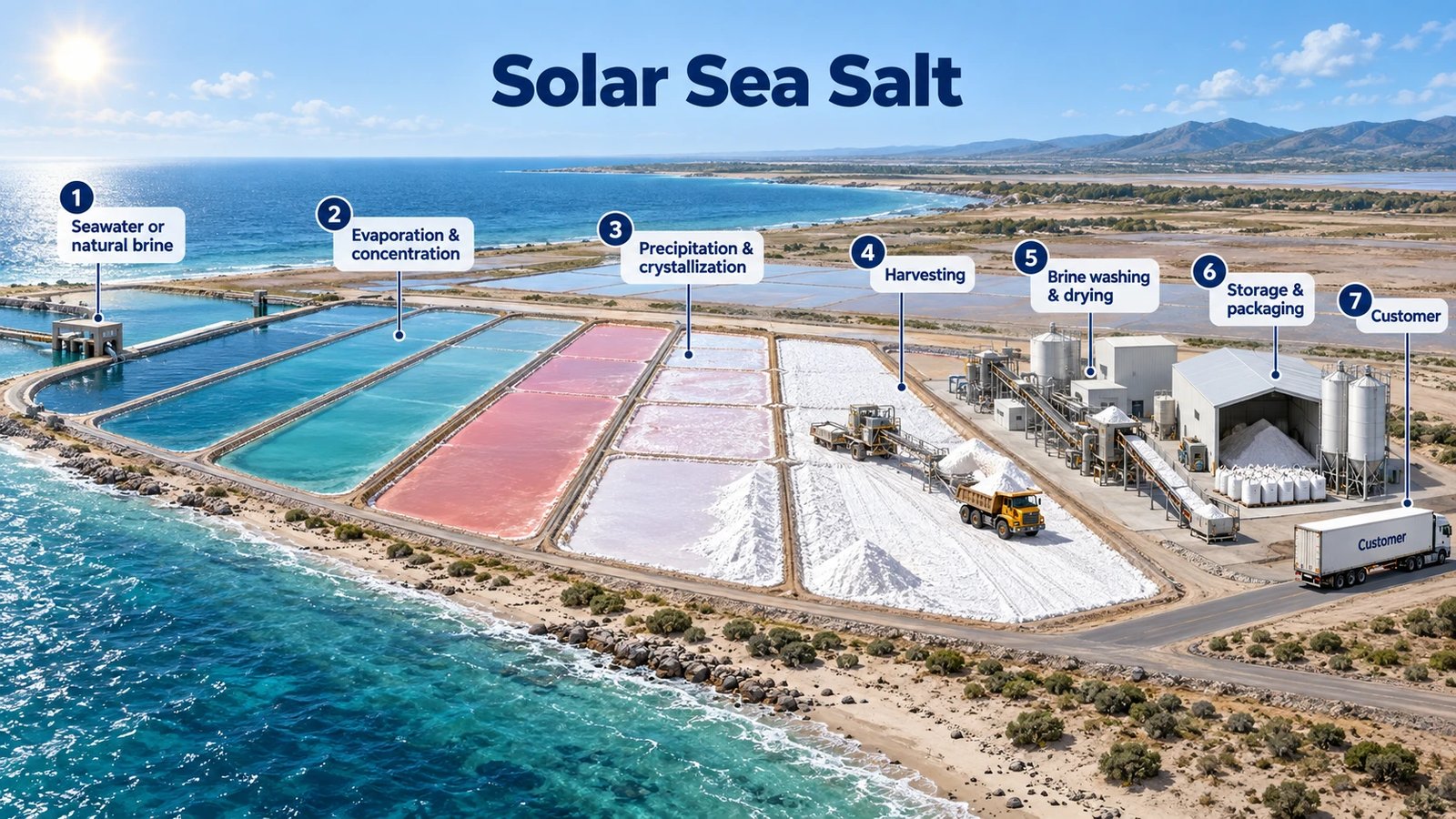
Solar sea salt production process, from seawater to customer
Our Method
Solar Sea Salt
Seawater is channelled into shallow coastal ponds, where sun and wind evaporate the water over several months. Salt precipitates and crystallises naturally, then is harvested, washed, dried and stored ahead of shipment. No fuel-fired evaporation — this is how PCE's supply is produced.
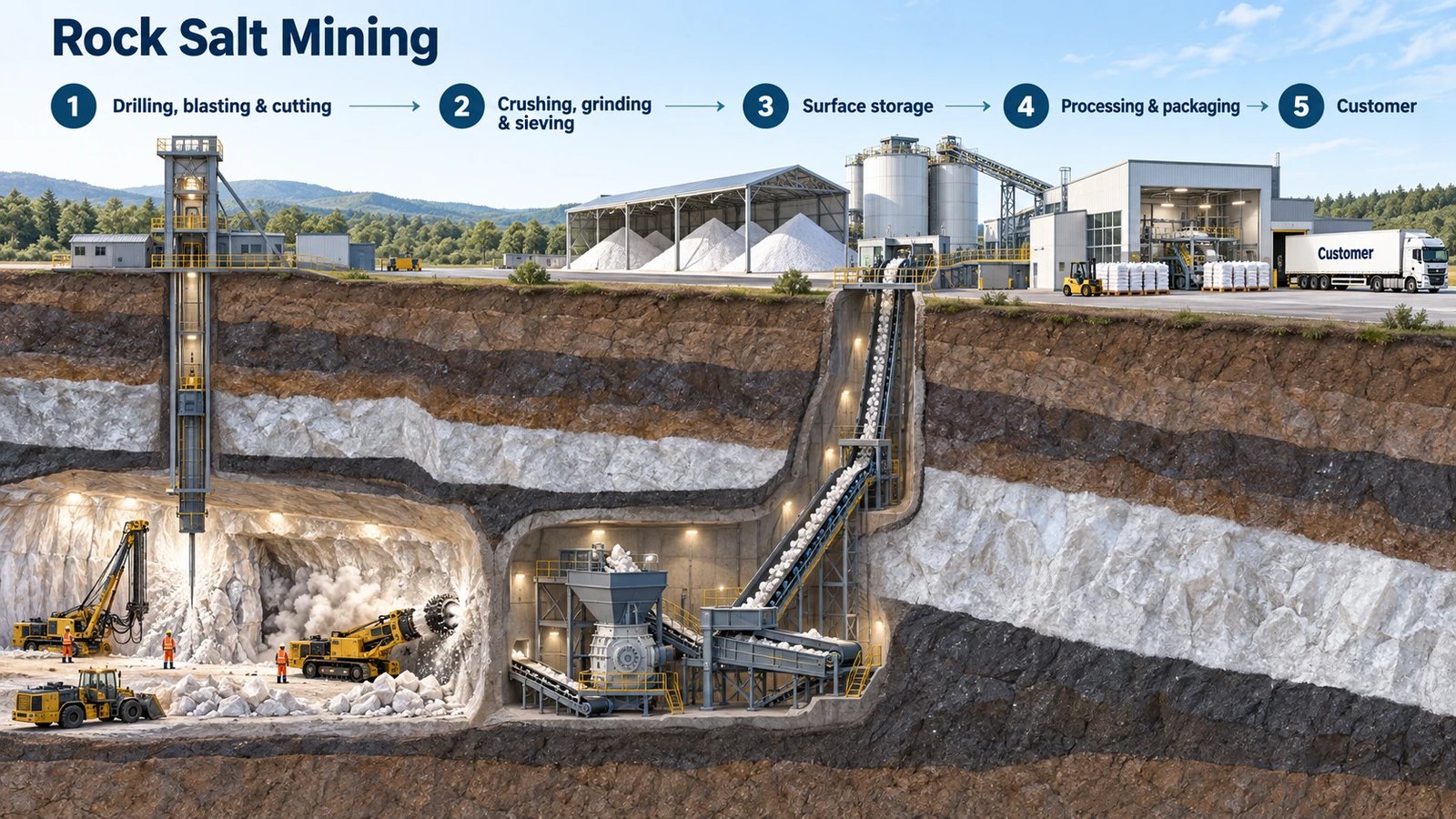
Rock salt mining production process
Rock Salt Mining
Underground salt deposits are drilled, blasted and mechanically cut, then crushed, graded and sieved at surface before processing and packaging — a common method for de-icing and some industrial grades.
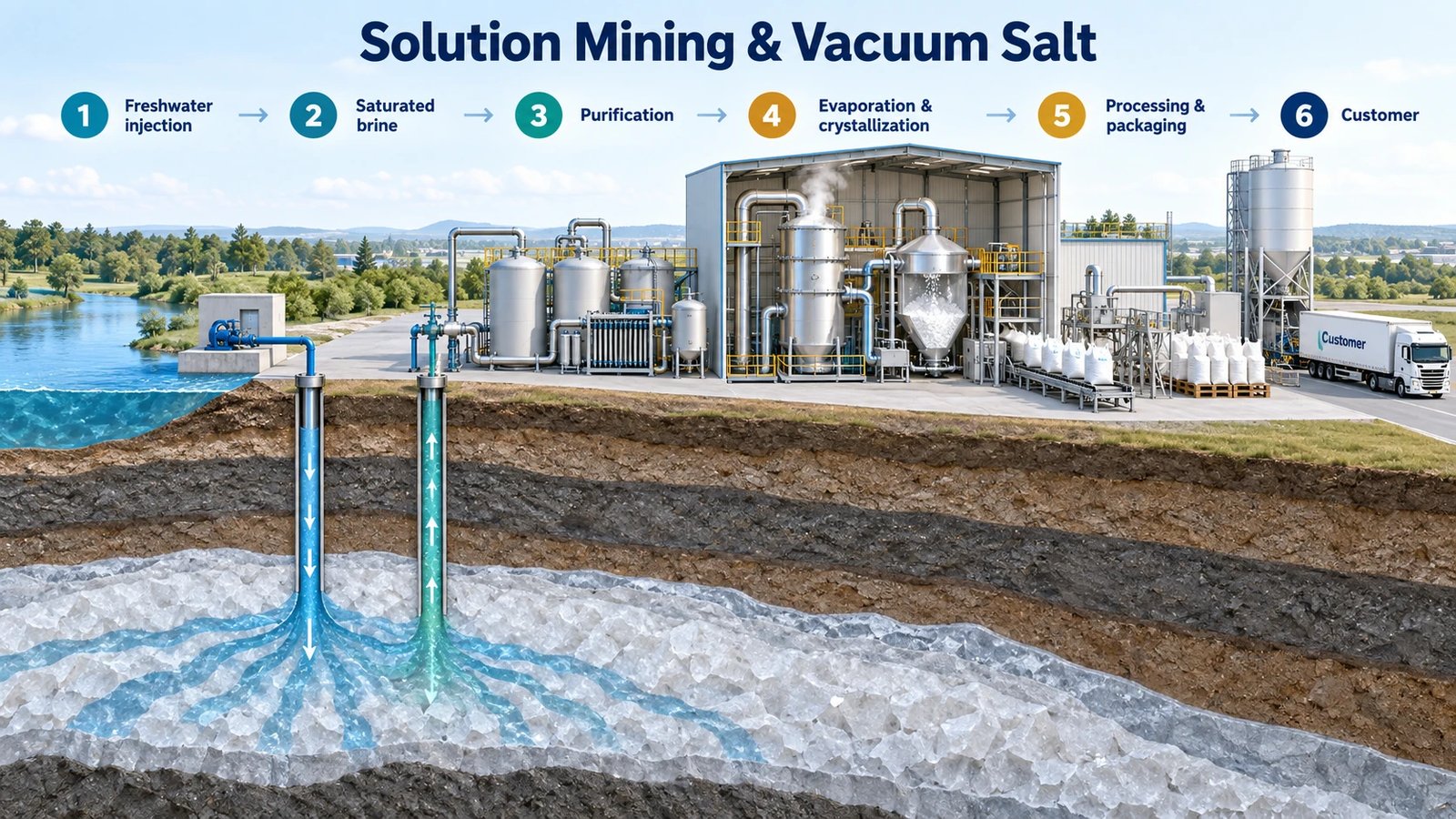
Solution mining and vacuum salt production process
Solution Mining & Vacuum Salt
Freshwater is injected into underground salt deposits to form saturated brine, which is pumped to surface, purified, then evaporated and crystallised under vacuum — typically used for high-purity vacuum salt such as PVD grade.

Seven steps — no fuel-fired evaporation

Industrial solar salt is made by concentrating seawater through natural solar evaporation, then harvesting, washing and loading the crystallised salt.

01
Brine Intake
Seawater drawn into the salt fields.
02
Concentration
Sun and wind evaporate water in shallow ponds.
03
Crystallisation
Salt crystallises in pans.
04
Harvest
Mechanical harvesting of raw salt.
05
Washing
Washing removes impurities.
06
Stockyard
Drained and stored near the port.
07
Loading
Clean handling onto the vessel.

Quality shared for your evaluation

Before committing to volume, buyers receive representative loadport samples and Certificates of Quality — independently verified, covering every parameter against the relevant grade specification.

Building on evaluation results, PCE moves toward a long-term framework: priority allocation of contracted tonnage, ongoing operations monitoring, and a transparent, flexible schedule aligned to your production and inventory plans.

~96.8%
Average as-shipped NaCl, wet basis — consistently within Grade I specification

Two export ports, flexible scheduling

Sourced from within the Kutch salt belt, Gujarat — giving flexible vessel scheduling and year-round delivery, even through poor weather.

01
Primary Gateway
Main export port for our Kutch-region production.
02
Deep-Water Access
Additional capacity for larger parcel sizes.

See bulk vessel classes and container formats on the Products page.

Full paper trail, every shipment

01
Certificate of Quality
From accredited third-party laboratory. Batch-specific, signed and stamped.
02
Material Safety Data Sheet
GHS-compliant, current edition, available in English.
03
Certificate of Origin
Issued by the relevant Chamber of Commerce at origin.
04
Bill of Lading / Sea Waybill
Full set or express B/L, negotiable or non-negotiable as required.
05
Pre-Shipment Inspection Report
Independent surveyor report covering weight, condition and sampling.
06
Phytosanitary / Fumigation
Where required by destination-country regulations.

Ready to move forward?

Share your specification, volume and destination — we'll confirm scheduling and documentation.